Recently in Cleantech & Renewable Energy Category

Bloom Energy Server - InstallationBloom Energy had a big week between the airing of its 60 Minutes segment on Sunday and the official unveiling on Wednesday. Thanks to some heavy-duty backers, big name customers and a gift for publicity, the fuel cell firm kicked it off in style. But as the buzz wanes, what kind of market will the Bloom Energy Server face? Will investors recoup the $400 million they fronted to get the venture off the ground?

Below are some choice links and insightful analysis on Bloom Energy and its impact on the cleantech marketplace.

Why Bloom Energy Is & Isn't the Google of Greentech - Earth2Tech

Kleiner Perkins Caufield Byers venture capitalist John Doerr, who led an investment in Bloom Energy and also in search engine giant Google, made the comparison as he took the stage during the launch event on the eBay campus. "This is like the Google IPO," said Doerr. Presumably, he meant the excitement and anticipation in the room, but also the potential for the type of returns that Bloom could bring to Kleiner.

Bloom box debut: More IPO than CO2 - Fortune Brainstorm Tech Blog

So if Bloom's magic boxes are still not cost-effective nationwide -- if they remain a niche product still in beta testing -- why today's star-studded coming-out party? Sridhar says his customers were so excited by the product they pushed him to unveil his creation now. Though they were clearly jazzed about the chance to brag about their green cred -- and moments at yesterday's event devolved into an orgy of self-congratulation -- many observers think Bloom had another motive: To prime the pump to go public.

Doing The Math On Bloom Energy - Forbes

The unsubsidized cost would be 13-14 cents/kWh, with about 9 cents/kWh from the capital costs of the Bloom box and 5 cents/kWh from natural gas costs, according to Lux Research. If natural gas prices rise or fall 50% (gas prices are often volatile), overall price would fluctuate from 11.5-12.5 cents/kWh to 20.5-21.5 cents/kWh. That price is still too high to compete in most markets with retail electricity without subsidy. However, this is the first generation, and if Bloom can bring prices down (and/or natural gas prices are stable/low), there could be a significant market for this fuel cell.

Much-Touted Bloom Fuel Cell Still Too Spendy - Wired.com

In fact, a long-term R&D collaboration between the Department of Energy and multiple solid-oxide fuel-cell manufacturers, the Solid State Energy Conversion Alliance, estimates that fuel cells will need to cost $700 per kilowatt of peak capacity to compete unsubsidized with the grid. Bloom's product costs 10 times that.

Bloom Energy By the Numbers - Earth2Tech

Carbon reduction: Bloom says that customers can get between a 40 and 100 percent reduction in their carbon footprint as compared with the U.S. grid, depending on if they are using natural gas or renewable methane. Michael Kanellos of GreentechMedia asked Sridhar during the Q&A session for the math on for 1 ton of CO2 emitted how much fuel would be used, and Sridhar didn't provide an answer.

Video: Q&A With Bloom Energy's Founder, Next Gen Fuel Cells and More - Greentech Media

There's an interesting connection between Bloom and Hara, the carbon management software company. Kleiner Perkins invested in both companies and both listed Coca-Cola as a signature client. In fact, Fortune 500 friends played an integral part of the launches of both companies. It gives the companies credibility. However, if Kleiner relies on the same names too much, it may begin to take the sheen off the impact.

...and from yours truly:

Bloom Energy and Data Centers - Perfect Together? (subscription required) - GigaOM Pro

Undoubtedly, many are wondering if a Bloom Energy Server, aka Bloom Box, will satisfy their growing energy needs. Sure, it will help them meet their carbon reduction goals and may even resolve some thorny siting issues, but let's zero in on two of the factors that matter most to the folks that run data centers: availability and cost.

Have you come across some interesting coverage? Share it in the comments!

Photo Credit: Bloom Energy

Bloom Energy Server - eBay InstallationBloom Energy Server, eBay Installation - Credit: Bloom Energy

Bloom Energy's fuel cell is making waves this week, starting with a 60 Minutes profile and culminating in today's official coming out party. (FYI: My colleague Katie at Earth2Tech has some excellent live coverage.) One thing you might have noticed is how Bloom is branding its fuel cell as an "Energy Server." Is it a smart move?

Yes.

The machinery traditionally used to generate electricity conjures visions of industrial dinosaurs, both in terms of the tech driving it and its size. Think turbines, generators, engines and the sort. Contrast that with a server, a tidy machine that's neatly stacked in the pristine racks of a data center. Servers are the workhorses that give the Internet life, brokering e-commerce transactions, disseminating Tweets, logging status updates... you get the idea. It's not hard to see how aligning Bloom's fuel cell with the high-tech IT realm -- inevitable, really, considering the company's pedigree -- is a clever strategy for the cleantech company.

As you're undoubtedly aware by now, the growth of web services and cloud computing is driving demand for power-hungry data centers, which will place added demand on the grid. And while Google may not have warmed to the idea of deploying "Bloom Boxes" in its data centers yet ("box" is another common term used for a server), eBay certainly appears smitten by the carbon reduction technology for its IT operations. Heck, it might even be the (pricey) solution to Facebook's coal-powered problem (sub. req'd).

ET Water SystemsET Water Systems announced today a new irrigation controller that can cut water consumption, and hence water bills, by up to 50 percent. According to the company, the system takes several factors into consideration when developing automatic irrigation schedules, including "plant type, soil type, sprinkler head type, sun exposure, and slope." And don't forget perhaps the most pivotal factor: weather.

ET Water certainly hasn't forgotten and it uses data from WeatherBug -- a company that's shaping up to become a smart grid technology provider and influencer -- to help maximize the water savings. Here's a snippet from the press release:

ET Water's platform integrates up-to-the-minute weather data from the WeatherBug network of 9,000 local weather stations across the country, along with evapotranspiration (ET) science to account for water that is lost from the soil through evaporation and through plant transpiration. By integrating these and other critical irrigation factors, ET Water's intelligent irrigation controllers and replacement controllers for legacy irrigation systems have proven to reduce water consumption by 20-50 percent, while promoting plant health and virtually eliminating harmful fertilizer and chemical runoff.

The Novato, CA-based firm's announcement comes as the water management tech scene heats up. Industry giants like IBM and Oracle see the space as a fresh and potentially lucrative market that can benefit from IT platforms. Given the critical importance of agriculture in the face of population growth, water scarcity and climate change, a healthy, IT-driven water management market in the years to come is virtually a given.

USA vs. China

In recent weeks, particularly after the President's State of the Union Address, there's been a lot of ink spilled on the topic of China's ascendancy in the cleantech space. Essentially, most arguments boil down to the danger of forfeiting the cleantech marketplace to China at the expense of American jobs and innovation. Dire stuff, but is it accurate?

In her piece for Yale Environment 360, "America's Unfounded Fears of a Green-Tech Race with China," journalist Christina Larson offers another picture, one that's a touch more sober. Take, for instance, one hot-button topic that closely orbits just about every discussion on the topic: jobs. She writes:

Most of the green manufacturing jobs that the U.S. stands to "lose" haven't in fact been created yet; China will gain thousands of new jobs, but not necessarily at America's expense. Moreover, the United States will still gain many new green-collar jobs, in installation and maintenance, which can only be locally based, as well as sales teams, conference planners, and other positions already arising to support the growing green-tech field.

As for the risk of falling behind in the technology race, it's best to take a deep breath and approach matters with a bit more objectively.

At present, America still has significant advantages -- including the world's leading university system and the entrepreneurial culture and venture-capital spigots of technology hubs, particularly Silicon Valley. "Intellectual property rights have done a lot to hamper China's development of green technology," says Linden Ellis, U.S. director of nonprofit China Dialogue. "People would rather come to Silicon Valley and develop a technology where they know it will be protected by the law, right down to every line, than go to China and try to develop a technology there where maybe the components will be cheaper and there is a lot of interest, but people do not trust that their findings will be protected."

My take? If you look at the near-daily funding news posted my colleagues at Earth2Tech, the majority dealing with US-based companies -- you'll see that there's no lack of cleantech activity and technologival advances sprouting up on our shores. A little friendly competition between countries, like companies, is a good thing and not something to stress yourself into ulcers about. When it comes to improving the world -- and profiting from it -- a little home-grown innovation can go a long way.

Turbine Light - TAK StudioHarnessing energy from the nation's roadways isn't a new idea but TAK Studio has a neat and visually striking twist on the idea.

As its name plainly implies, Turbine Light combines roadside lighting (LED?) with a turbine that captures wind and harvests breezes caused by passing vehicles. The concept is one of the entries in the Greener Gadgets design competition taking place in NYC on February 25.

Image Credit: TAK Studio

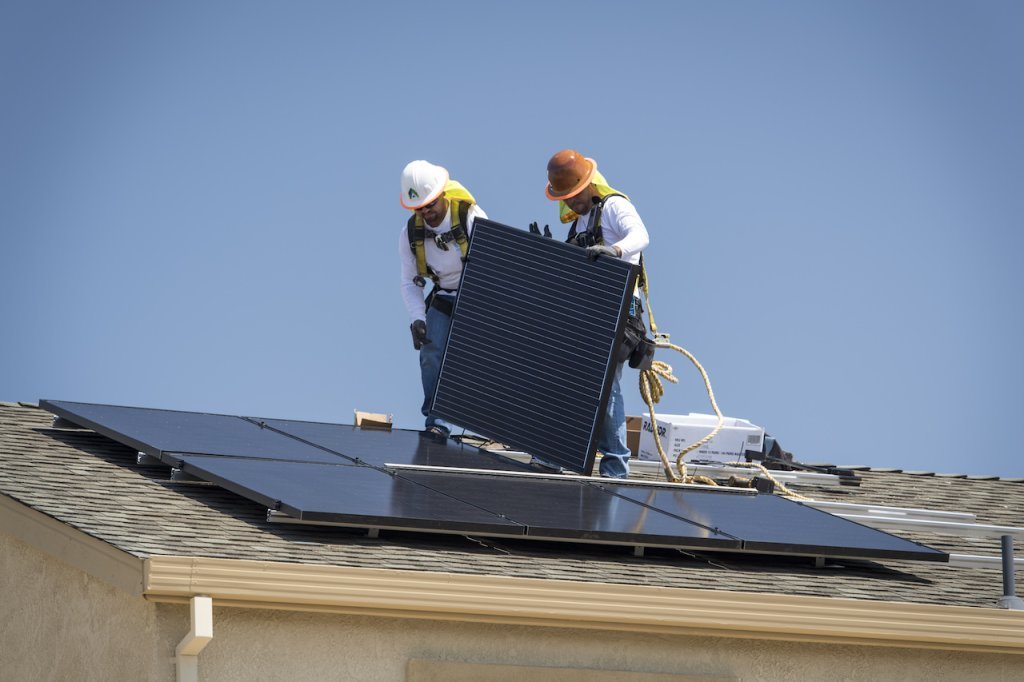
Solar Panel

Some solar companies are stepping up to help the people of Haiti after a devastating earthquake flattened entire swaths of the country's capital, Port-au-Prince, leaving behind scores of injured residents and claiming untold numbers of lives.

Geek.com spotlights some of the companies that are generously contributing to the relief efforts. SolarWorld sent solar panels to power ten water pumping stations and solar streetlamp maker Sol has sent 15 units and plans to send 100 more.

Well done!

Photo Credit: Jeremy Levine Design - Creative Commons

Solar Panel Zone41/Flickr Creative CommonsGood news Garden State residents, our beloved New Jersey is second only to California in installed solar, but number one in solar installed per square mile. One of the reasons is that incentives are accelerating the payback period.

CNBC reports:

Considering all three sources of funding, their contractors estimate that it should take the couple a little under five years for the solar panels to pay for themselves. "We thought it would take longer, like 10 to 12 years," adds Bob.

There's something in it for businesses too:

For its distribution hub in Woodbridge, N.J., FedEx Ground has a similar deal. The company is allowing BP to install and operate a solar power system on its roof, while FedEx Ground buys the energy created to power its building.

"It's less expensive than getting power from the utility," says Paul Viccaro, managing director of facilities at FedEx Ground. FedEx has three other facilities with solar roofs, all located in California.

[via Slashdot] Photo credit: zone41/Flickr - Creative Commons

William_Kamkwamba.jpg

In covering green IT, or technology in general, I don't have to look far for people that exhibit ingenuity and passion. (And make a buck, who are we kidding.)

William Kamkwamba of Malawi stands apart, and not because he hails from an impoverished part of the world. His story is one of determination, true DIY spirit and a desire to improve his, his family's and his community's lot in life by harnessing the wind's power. Wired's Kim Zetter excellent profile is a good introduction to Kamkwamba's accomplishments, but I also encourage you to watch his wonderful TED appearance in 2007 and keep an eye on a forthcoming documentary based on his story.

Image Credit:Tom Rielly/TED

Apollo 11 - NASA Forty years ago, astronuats first stepped on the moon. Today, the field of green tech has plenty of reasons to thank NASA for the pioneering advancements surrounding the history-making journey. Brian Coppa at Examiner.com lists five areas that have benefited from NASA's pursuit of scientific. My favorite?
Computer technology: Structural Analysis - NASA program, originally created for Green design and controls, has been employed in a broad array of non-aerospace applications, such as the automobile industry, manufacture of machine tools, and hardware designs; Air Quality Monitors - utilizing a NASA-developed, advanced analytical technique software package, an air quality monitor system was created for separating the various gases in bulk exhaust streams and determining the amount of specific gases present within the stream for compliance with emissions standards...

Source

Baryonyx LogoBaryonyx, a Texas startup, is embarking on projects to build green datacenters and the wind farms to power them. Data Center Knowledge reports:
Baryonyx plans to build a 28,000 square foot data center in Stratford, which will be powered by 100 wind turbines built on the adjacent land that will generate up to 150 megawatts of power. Each of the turbines will be able to generate up to 3.3 megawatts of power. Capacity not needed by the data center will be sold to local utilities. Baryonyx said it will take about 3 years to reach the operational phase for the wind-powered data center.

The outfit is also planning two more facilities in the Gulf of Mexico to benefit from its 38,000 acres worth of offshore Texas wind energy leases.

Source [via Slashdot]

Archives