Results tagged “iPhone”

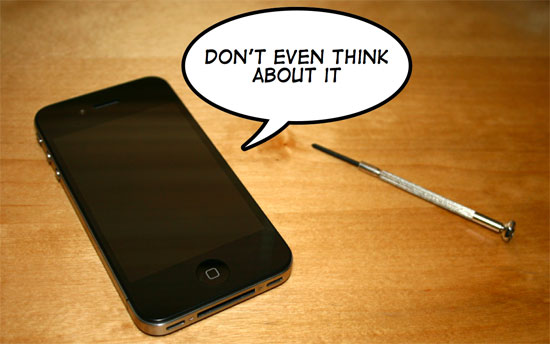
iPhone Mount Made of TacksCubicle dwellers, your dirt-cheap iPhone mount has arrived. And all you have to do is raid the office supply closet for a handful of tacks.

This Lifehacker gallery shows a clever iPhone hack (click on number 2) that you can use to keep your iPhone at eye level and at arm's length without investing in an overpriced accessory that will end up getting recycled in a year or two. From the description:

The tacks are actually just the right size and shape to wrap around the edges of the phone without trouble or fear of it falling out. I use it along with a fullscreen clock app to keep track of the time, but it's also at just the right height to watch a Youtube video or see the album art while working.

Way to help out our landfills, Bill!

The Great Wireless Power Wait

PowermatYou might be thinking, "What wait, it's here now?" Well yes, and no.

Over the years there have been gadgets like electric shavers, toothbrushes and even the Palm Pre (optional) that can be charged without ever plugging them into a power adapter. Just plop them on their bases and a few hours later, they're charged. The problem is that the are, for lack of a better term, single minded. They won't charge any other devices except for the ones they were designed for.

This leads me to the inspiration for this post: the Powermat (pictured above). I saw one today at Target, and overcoming my early adopter/impulse gadget buying tendencies, I just walked away from the enticing endcap empty handed (the spendy price tag helped too). While it's a step in the right direction, it suffers from what's preventing wireless charging systems from taking off.

Like Stacey at GigaOM Pro noted in her piece "Wireless Power: Beyond Charging Mats and Solar Panels" (subscription required) wireless charging technologies are, and will likely remain, a niche technology. One problem that's holding the technology back, and that the Powermat somewhat addresses, is the lack of device compatibility. Powermat solves this with adapters (called receivers, one included) and tips that allow popular devices like iPhones, iPods and Nintendo DS/DSi's to use the mat.

On the downside, the adapters that people really want for their iPhones and BlackBerries add considerably to the cost of the system, which starts at $100.00. Plus, some of the adapters just replicate the functionality of plug-in adapters by requiring that the gadgets you want to charge are, well, plugged in. Also, the product's vampire power reducing smarts are somewhat negated by the inherent inefficiencies of wireless charging technologies (70 percent is the best that they can do currently).

On the plus side, it does reduce the number of wall warts you'll have plugged in, it's ultra-convenient to keep your gadgets charged and it's just plain cool. Sadly, it's not enough to justify dropping $100-plus for me, at least not until charging efficiency improves and more handset and portable electronics makers settle on a universal, integrated standard.

I'm hugely optimistic about wireless charging, but the approaches to banishing cables and chargers (thereby reducing e-waste) is a piecemeal in the here and now. Let's hope device makers can improve wireless charging efficiency and cook up some standards for easy, cost-effective integration into all portable electronics. They will earn the esteem and eternal gratitude of anyone that forgot to pack a charger or nearly got electrocuted by those funky hotel lamps with the power outlets in the base.

Update: Gizmag has a great review of a similar system called Wildcharge, which illustrates some the shortcomings of wireless charging devices.

MightyMintyBoost Solar iPhone and iPod Touch Charger
Here's a neat Instructables project if you'd like to charge your iPhone or iPod Touch using the sun's rays (and a little elbow grease). Using an Altoids tin--the modern tinkerer's mobile enclosure of choice--and roughly $70 in parts, you too can build this solar variant of the MintyBoost.

As the MightyMintyBoost guide points out, if every one of the 30 million iPod Touch/iPhones that Apple sold "was fully charged every day (averaging the battery capacity) via solar power instead of fossil fuel power we would save approximately 50.644gWh of energy, roughly equivalent to 75,965,625 lbs. of CO2 in the atmosphere per year."

If you're new to solar projects, this is a good start. Who knows, you may get bitten by the bug and start some more ambitious solar installs.

Examiner.com has a great article on the MightyMintyBoost's inventor, Jerome Kelty, that's also worth a read.

Thomson Reuters reduces storage sprawl to save money, increase quality
2009 InfoWorld CTO 25 Awards: Christopher Crowhurst - InfoWorld

The server virtualization -- paid for by the storage optimization savings -- did more than consolidate servers. After five months, the two efforts let Thomson Reuters achieve 77 percent utilization across backup systems (and 99.6 percent across 694TB of secondary storage), reclaim 159TB of storage through deduplication, and reduce annual capital and operating expenses by a combined $12 million per year. On the "green IT" front, the expected accumulated power savings over eight years will let the company defer building three new datacenters at the cost of $60 million each and reduce carbon emissions and load on the power grid.

Green-memory movement takes root - EETimes.com

Processor power consumption ranges from 45 to 200 W, according to Intel. In a server with eight 1-Gbyte dual in-line memory modules, the DIMMs can contribute 80 W to the power budget, according to Intel. In large servers with up to 64 DIMMs, the result could be "more power consumption by memory than processors," Intel notes.

Intel incorporates "automatic memory throttling" on its processors to reduce heat. DRAM vendors are also reducing heat generation in their latest 50-nm-class parts, exemplified by those from Hynix, Micron Technology and Samsung.

Top Five Green Apps for the iPhone - Greenzer.com

1. MeterRead by ZeroGate, $4.99

This app (pictured above) takes a simple concept--monitoring your energy use--and uses the iPhone to make it even easier to do. Reading your meter on MeterRead and checking it regularly will allow you to know what your bill will be at the end of the month so you can budget accordingly, or better yet, work on ways to reduce your power consumption. It's not free or even $0.99, but MeterRead can quickly pay itself off if you invest the time in learning it and using it.

Sun Enhances OpenSolaris OS For Virtualization Tasks - ChannelWeb

OpenSolaris 2009.06 includes networking technology developed under the name Project Crossbow which, for the first time, offers networking capabilities designed for virtualization, according to Sun. Under Project Crossbow, the operating system provides virtual network interfaces that work in combination with multicore, multithreaded processors, Sun said.

EMC Turns Spoiler; Outbids NetApp - Virtualization Journal

EMC is proposing to outbid NetApp for Data Domain, the dedupe house that NetApp agreed to buy the week before last for $25 a share in cash and stock, a price valued at $1.5 billion.

Go green: Turn off your computer with your iPhone/iPod Touch - CrunchGear

Why didn't any of us think of this? The creator of a VLC controller app for the iPhone has just released a clever little app that turns off your Windows or Mac PC (see what I did there?) remotely.

Fujitsu Goes Green With 'wind-powered' Laptop - PC World

Fujitsu began selling in Japan on Tuesday a laptop that runs on wind power -- well, almost. The company is purchasing wind power "green energy credits" for each of the "FMV Loox" laptops sold that are equivalent to the amount of electricity estimated to be used by the machine over a four year lifespan.

VMware warns that revenue may fall for the first time in Q2 - Computer World

But VMware said that software license sales declined 13% from last year's first quarter, to $257 million, as customers cut IT spending and signed fewer large deals. The drop was offset by a 48% jump in service revenue, which includes software maintenance fees and is becoming a larger part of VMware's business.

HMIs: Thin client milestone; new box-form industrial PC - Control Engineering

ThinManager gives system administrators the ability to configure and monitor every thin client and Microsoft terminal server throughout the entire company with a single management tool, and provides support for configuration and calibration of all Advantech's monitors and touch screens. With specs ranging from a 400 MHz GX-2 CPU and 256 MB RAM to a 1 GHz Celeron M processor with 512 MB RAM, the Advantech ThinManager ready thin clients are appropriate for low power consumption in tight enclosures.

ADC Data Center Saves On Emissions - Web Host Industry Review

The data center is built using recycled, non-toxic, locally-sourced/manufactured materials and over 95 percent recycled demolition debris.

By saving electricity, ADC is also saving valuable water resources.

When compared to the average data center, ADC says it will save 220.5 million gallons of water -- enough to fill 18,375 swimming pools -- a year, to meet its electrical energy demands.

PeaPod and iPhone
iPod/iPhone and car integration is nothing new, but Chrysler's electric car the PeaPod takes matters a bit further.

AutoblogGreen scoped out Peapod Mobility at the New York Auto show and found some interesting ways the iPhone will interact with the cute as a button EV. Not only can you start the car with the phone, it will also act as a nav screen and act as a Green Meter that displays how much money you're saving on gas you'd otherwise be burning.

Source: AutoblogGreen

1

Archives